We sat in on a workflow review for a Dubai logistics client last month, and the operations lead said something we haven't stopped thinking about: "Our bot still answers questions about our competitors' shipping rates if you ask it nicely enough." That bot had been live since before the policy change. Nobody had touched it since. It still hasn't been touched.
This is the real story of Meta's WhatsApp policy shift. Not that it happened. Everyone with a LinkedIn feed knows it happened. The real story is that it happened, the deadline passed, and a large share of the businesses running WhatsApp automation across the UAE simply kept operating exactly as they were before. They didn't ignore the announcement. They just didn't know what "compliant" actually looks like in practice, so they assumed the old setup was fine because nobody knocked on their door.
What Actually Changed, In Plain Terms
Meta's update, which barred general-purpose chatbots from the WhatsApp Business Platform, was never really about banning AI. It was about banning a specific category of AI: the open-ended, ask-me-anything bot that behaves more like a search engine than a support agent. A bot that can answer "what's the capital of France" or riff about a competitor's pricing is, in Meta's framing, no longer allowed to exist inside a business WhatsApp number. Support-scoped, task-specific AI is fine. Actually, it's required, since Meta's own guidance now positions AI-driven support as the expected standard rather than the exception.
The Distinction Nobody Is Explaining Clearly
Here's the analogy we use with clients who glaze over at the word "policy." Think of your WhatsApp bot like a hotel concierge desk. A general-purpose chatbot is a concierge who will discuss the weather in Reykjavik, debate football scores, and speculate about a rival hotel's room rates, because nobody told him his job has a fence around it. A compliant support bot is a concierge who has been told, clearly, on his first day: "You handle bookings, room service, and checkout questions. Anything outside that, you say 'let me get someone who can help' and you hand it off." Same person, same desk, completely different liability exposure for the hotel.
Most Dubai SMEs built the first concierge. They're still running him.

The Three Gaps We Keep Finding in Live Audits
When we run a WhatsApp workflow audit for a UAE client now, we're not looking for whether they have a bot. Everyone has a bot. We're looking for three specific failure points, and we find at least one of them in nearly every account we review.
Gap One: Opt-In Records That Would Not Survive a Second Look
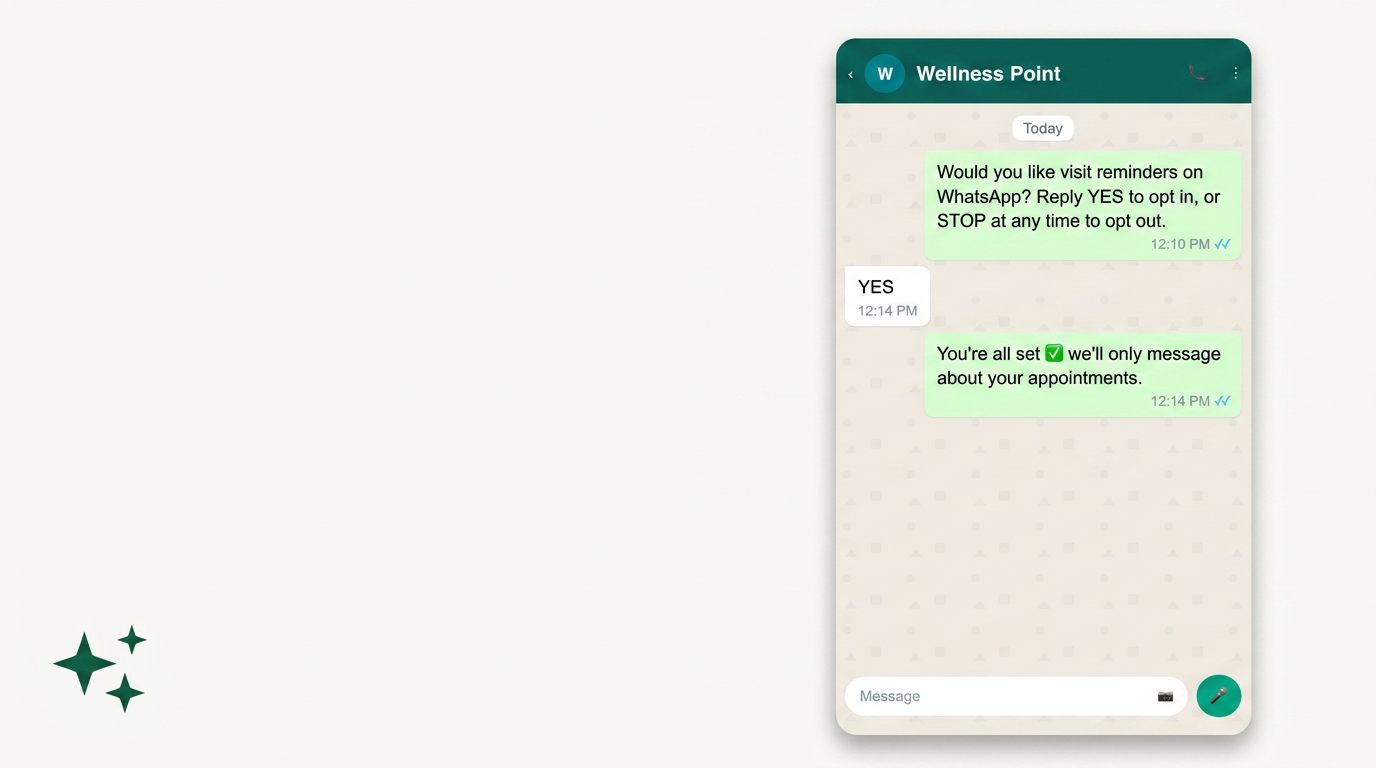
Meta's opt-in requirement isn't new, but enforcement pressure around it has tightened considerably alongside the AI policy. The rule is simple to state and apparently hard to execute: you need documented, unambiguous consent before a customer receives a business-initiated WhatsApp message, and that consent needs to be traceable. According to Meta's updated opt-in guidance, a customer messaging you first does not automatically grant you standing permission to run them through a promotional flow six weeks later.
What we find instead: a WhatsApp number that was seeded from a CSV export of an old email list, with zero record of who actually agreed to WhatsApp contact versus who just once filled out a contact form for something unrelated. One retail client had built their entire remarketing sequence on a list like this. When we asked to see the opt-in trail, there wasn't one. Just a spreadsheet and a prayer.
Gap Two: Message Quality Scores Nobody Is Monitoring
Message quality rating determines your ability to send at all, and Meta uses it as a blunt instrument. Low quality means throttled sending, restricted templates, and eventually a locked number. Yet in our audits, roughly half the businesses we assess have never once looked at their quality dashboard. They set the automation up, it worked, and they walked away. That's the equivalent of installing a smoke detector and removing the battery because the beeping was annoying.
Gap Three: A Chatbot Scope That Was Never Actually Defined
This is the big one, and it's the direct consequence of the January change. Ask most business owners "what can your WhatsApp bot NOT do," and you'll get a blank stare. That question should have a crisp, written answer. Instead, the bot was built by a freelancer eighteen months ago, trained on a broad prompt like "be helpful and answer customer questions," and left to its own devices. That prompt is now, functionally, a policy violation waiting to be flagged.
Why the Industry's Favorite Fix Is Actually Wrong
Here's where we'll say something that goes against what most agencies are telling clients right now. The dominant advice in the market is: "add a disclaimer, add a human handoff button, and you're compliant." We think that's close to useless on its own, and here's why.
A disclaimer that says "I am an AI assistant" does nothing to change what the bot is actually capable of discussing. It's cosmetic. It's a warning label on a product that hasn't changed. Compliance under this policy isn't about disclosure, it's about scope. A general-purpose bot with a disclaimer bolted on is still a general-purpose bot. Meta's enforcement, based on everything we're seeing referenced in platform compliance guides circulating among UAE resellers, looks at behavior patterns, not badge text.
As one operations manager at a Dubai clinic group put it to us during an onboarding call: "We added the little AI disclaimer message everyone told us to add. Took ten minutes. Felt like we'd fixed it." They hadn't fixed anything. The bot could still be walked, through five or six messages, into discussing unrelated medical advice completely outside their service list. The disclaimer was decoration on a structural problem.
What Rebuilding Actually Looks Like
Fixing this properly is not a ten-minute task, and we won't pretend otherwise. But it's also not a six-month rebuild. For most SME-sized deployments, this is a two to three week project if it's approached correctly.
Start With a Written Scope Document, Not a Prompt Tweak
Before touching the bot's configuration, write down, in plain language, every category of request the bot is allowed to handle. Booking confirmations. Order status. Store hours. Refund policy questions. Then write down, equally explicitly, what happens the moment a message falls outside that list. Not "the bot tries its best." A hard handoff to a human queue, every time, with no exceptions carved out for "but the AI is pretty confident it knows the answer."
Re-Verify Your Opt-In List Before You Send Another Broadcast
This is unglamorous work and nobody wants to do it. Pull every contact currently receiving business-initiated messages and cross-reference against your actual consent records. If you can't produce a timestamp and a clear opt-in event for a contact, that contact comes off the broadcast list and goes into a re-permission flow instead. We've seen UAE businesses lose 30 to 40 percent of a list doing this exercise properly. That's not a bad outcome. That's the list you were always supposed to have.
Audit Your Message Quality Score This Week, Not Eventually
Log into your Business Manager, find the quality rating for your number, and actually read it. If it's flagged medium or low, stop sending broadcast campaigns immediately and diagnose why, usually it's a mix of template mismatch, response latency, or block rates from the very list you just should have cleaned in the step above.

Rebuild the Bot Around Escalation, Not Elimination
Some agencies are telling clients to strip AI out of WhatsApp entirely and go back to static menu buttons. We think that's an overcorrection that throws away the actual value of the channel. The fix isn't less AI. It's AI with a fence around it, exactly like the concierge with the defined job description. A scoped support bot that knows five things cold and hands off everything else instantly will outperform, and stay compliant far better than, an open bot that knows a hundred things poorly.
The Cost of Doing Nothing
The businesses treating this as optional are making a bet: that Meta's enforcement is slow enough, and their volume small enough, that they'll never get flagged. Maybe that bet pays off for a while. But every quarter that passes with an unaddressed opt-in gap or an unscoped bot is a quarter of accumulated exposure, not just to Meta's own penalties, but to the customer trust damage when a bot says the wrong thing to the wrong person at the wrong moment, publicly, in a screenshot that ends up on social media.
We'd rather our clients spend three weeks fixing this properly now than spend three days scrambling after a number gets suspended mid-campaign.
If you're not sure whether your WhatsApp setup would survive a real audit, that's usually the clearest sign it wouldn't. Let's walk through your current workflow together and find out before Meta does.