There is a habit we keep meeting when we audit the messaging setups of clinics and agencies, and it looks completely harmless. Someone on the front desk keeps a saved list of phone numbers in a spreadsheet, collected over years from walk-ins, referrals, event sign-ups and a website form that never mentioned WhatsApp. When a new automation goes live, that list gets imported, because why wouldn't it. The numbers are real. The people are real customers.
That import is the single most expensive five minutes in most WhatsApp projects. Nothing visible breaks on day one. Quality ratings slide, templates that were already approved get paused for negative feedback, the number gets flagged and its messaging limit drops a tier, and eventually the outbound half of the booking flow spends every day pressed against a ceiling. Nobody files a ticket saying the WhatsApp channel died because of a spreadsheet. They just say the automation stopped working.
Underneath that habit sits a set of documents almost nobody on the operations side has opened: Meta's published terms and policies for the WhatsApp Business Platform. The parts that decide whether your AI assistant is fine or finished are far fewer than the page count suggests, and this piece walks through the ones that govern chatbots specifically: what the 2026 AI rules allow, what they ban, and how to check which side of the line your assistant sits on.
What the official WhatsApp Business Platform terms say about AI chatbots
The official WhatsApp Business Platform terms and Meta's AI chatbot policy permit a business to use AI to handle conversations with its own customers, and nothing in them requires a human to type every reply. The restriction that made headlines is narrower than most operators assume: as TechCrunch reported when the change was announced in October 2025, from January 15, 2026 WhatsApp bars third-party general-purpose AI assistants from operating on the platform in most markets, a change Meta linked to increased message volume and system strain from usage the channel was never designed for. Meta confirmed at the time that businesses using AI to serve their own customers, a travel company's support bot for instance, were unaffected, and put it this way: "The purpose of the WhatsApp Business API is to help businesses provide customer support and send relevant updates." If you are a clinic, salon or agency running an assistant that answers questions about your services and books your appointments, that ban is not aimed at you.
The binding language now sits in Meta's WhatsApp Business Solution Terms, which strictly prohibit AI providers from using the Business Solution to provide AI technologies where those are the primary, rather than an incidental or ancillary, part of what is on offer, and which let Meta terminate accounts for breach. Two scope details matter. The current version carries an effective date of March 6, 2026, and, after objections from competition regulators, it exempts users with EEA or Brazil phone-number country codes. For a Dubai audience the restriction applies as written, while EEA and Brazilian numbers now sit outside it.
Since the restriction took effect, a lot of anxious reading has gone in the wrong direction. Teams spend weeks worrying that their booking assistant might count as a general-purpose chatbot while never opening the policy pages that actually govern how they collect permission to message people.

Sorting your assistant from the thing that got banned
The distinction Meta drew is about who the assistant serves and what it is for, so read the restriction with two questions in hand.
The first: whose customers is this assistant talking to? An assistant that exists to answer questions about your treatments, your availability and your prices is a business serving its own customer base. A general-purpose assistant is one that any member of the public can message to ask about anything at all, using WhatsApp as a distribution channel for a product that has nothing to do with a specific business relationship. That is the category the ban addresses.
The second: what is the scope of the conversation? Our assistants are deliberately narrow. They know your services, your opening hours, your booking rules and when to fetch a human. They do not answer general knowledge questions, write essays or hold open-ended chats, and that narrowness maps straight onto the Solution Terms' own test: the AI is an ancillary part of a booking service, and the treatments being booked are the product.
Air traffic control has a phrase for the volume of aircraft a sector can safely handle before separation starts to fail. Meta's stated reasoning, message volume and system strain, is the same concern expressed in platform terms. A few thousand clinics each running a scoped booking assistant is normal traffic. One consumer assistant with millions of users routing every query through the same pipe is the traffic the restriction was written to keep out of the sector.
Reading it before your provider tells you what it means
Read the actual announcement and the published policy pages yourself rather than relying on a summary from a software vendor. Vendors have an interest in telling you their product is unaffected, and most of the time they are right, but you want to be able to check. TechCrunch's October 2025 report is easy to find, and the Business Solution Terms linked above carry the current binding wording, effective date and all. If a summary and the source disagree, the source wins.
Meta publishes several layered documents for the Business Platform, and your Business Solution Provider stacks its own terms on top. How to locate the binding versions, what order to read them in and how to tell a rule from a suggestion is a separate skill, and we walked through it clause by clause in our contract reader's guide to these terms. This piece stays on the narrower question: what the AI rules allow and ban for a business chatbot, and how to check yours.
Post-mortem on an assistant that lost its number
What follows is an illustrative composite assembled from the shape of several clean-up jobs rather than any one client, with no real figures attached.
What was built. A multi-branch clinic ran an AI assistant on WhatsApp handling enquiries, price questions and bookings. Solid build. It answered in Arabic and English, handed to a human when a clinical question appeared, and pushed confirmed appointments into the practice management system. Reception stopped answering the phone mid-treatment.
What was added later. Marketing wanted the same number for campaign sends. They exported the CRM's full contact list, mapped it into a promotional template and scheduled it. Nobody checked which of those contacts had ever given permission to be messaged on WhatsApp, because the CRM had a single marketing consent field that predated the WhatsApp channel entirely.
Where the flags went up. Recipients who did not recognise the sender blocked and reported, and the quality rating gave way. The mechanics are laid out in AWS's quality rating documentation for WhatsApp: the score is built from the past seven days of user feedback, blocks, reports and the reasons people give when they block a business, weighted towards the most recent. Approved templates started getting paused for recurring negative feedback, the number was flagged, and when the rating had not recovered within seven days its business-initiated conversation limit was lowered a tier. Here is the part that stings: the flag did not distinguish between the campaign and the booking assistant. The lowered ceiling throttled the compliant, working part of the system along with the part that caused the problem, until outbound sending was effectively dead.
Cause of death. Not the AI, and not the template wording, which had been approved. The cause was treating one consent record as though it covered every channel and every kind of message, then running promotional traffic down the same number as operational service traffic. Controllers do not stack every category of movement into one approach path and hope the spacing holds; separation is the entire discipline. One number carrying two kinds of traffic with two very different risk profiles has no separation at all.
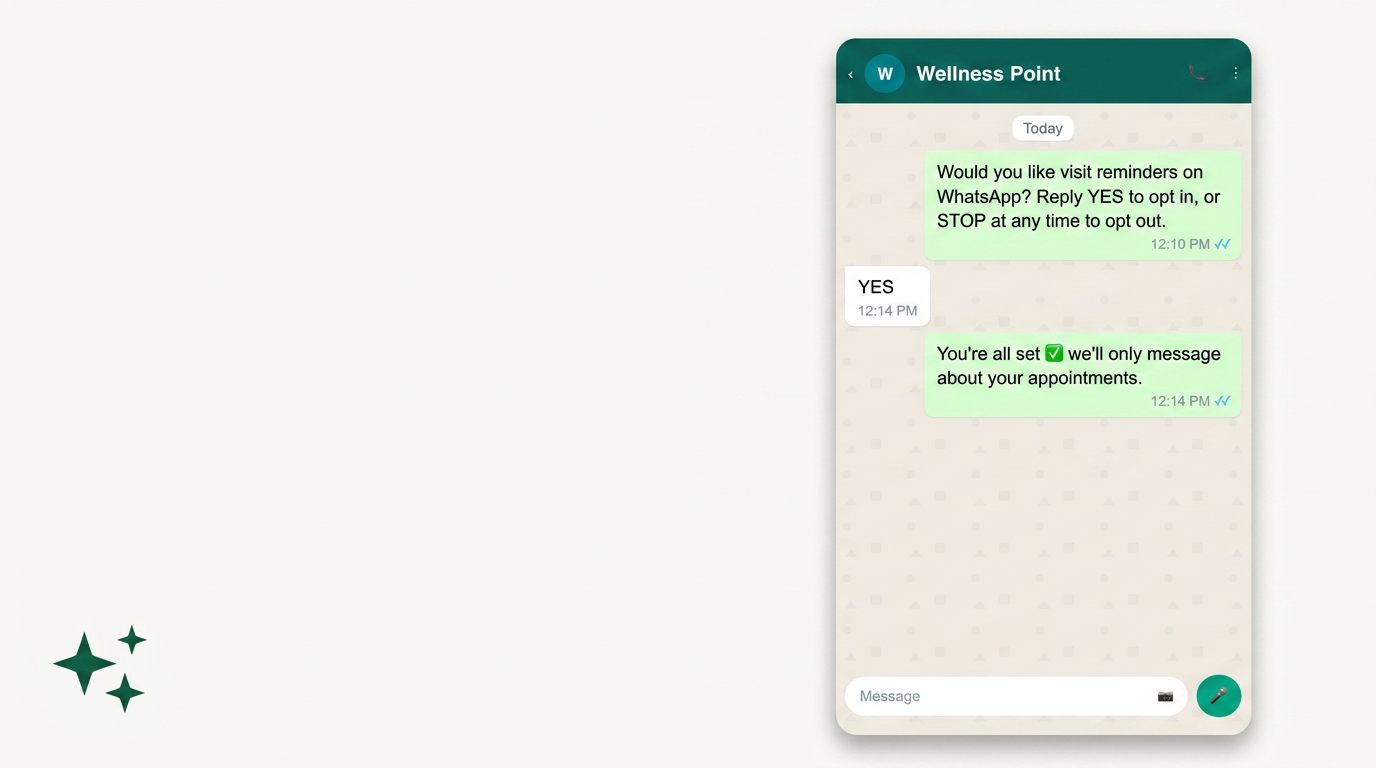
The safeguard costs nothing: someone reads the permission section of Meta's WhatsApp Business Messaging Policy before the export runs, and asks whether the consent on file matches the consent the policy describes, a number the person handed over themselves plus their confirmation that they want subsequent messages from you on WhatsApp.
Translating clauses into things you can actually inspect
Reading is only useful if it changes what you look at in your own system. When we read a policy page, we turn each obligation into a question we can answer by opening a screen, and we keep the questions in the same order as the documents so anyone can retrace the work.
Permission clauses become a consent trace, the exercise Meta's developer documentation on getting opt-in makes concrete: pick five numbers at random from your sendable list and try to produce when, where and with what wording each person agreed to hear from your business on WhatsApp. The opt-in itself has requirements, it must clearly state that the person is agreeing to messages, name your business and comply with local law, so vague marketing consent from a form that never mentioned WhatsApp does not qualify. If you cannot do the trace for all five, the list is not ready, and no amount of clever assistant logic fixes that. This is the single exercise we would keep if we could only keep one.
Category and template clauses become an audit of what you have already had approved: read each template as a stranger receiving it cold, and be honest about which ones are really promotional. Outbound trigger clauses become an inventory: list every point in your automation that can send a message the customer did not just ask for, and confirm each one has a permission basis behind it. Opt-out clauses become a test: unsubscribe yourself, then run your next CRM sync and check you are still unsubscribed. That last one fails more than any other, because suppression lists get quietly overwritten by imports. The zero-trust implementation path we use assumes every integration will eventually push bad consent data back at you and makes the suppression list authoritative over everything else.
The trigger list Meta will never write for you
Meta does write the escalation clause. The same Business Messaging Policy requires businesses using automation to keep prompt, clear and direct escalation paths to a human agent available, whether that is a handover inside the thread, a phone number, an email address or web support. What the terms leave for you to write is the trigger list: which symptoms, disputes or distress signals force the handover, and how fast it has to happen. That judgment layer is yours to design, and in health and finance your own regulator will care about it more than Meta does.
People message a clinic when they are worried about a lump, a bill, or a treatment that did not go the way they hoped. An assistant that opens with a joke and an emoji makes an anxious person feel unheard and makes the business look unserious. We build assistants that are professional and warm, identify themselves as assistants without being asked, and hand over the moment a conversation carries clinical, financial or emotional weight. Ours usually escalate on any question about symptoms, medication or results, any dispute about money, any sign of distress, and any request to speak to a person. AI earns its place in a service business by taking repetitive load off staff so those staff can do the human part properly.
At Learnmind, a Dubai firm that wires AI into the front desks of service businesses, the handover rule is the first thing we configure on every build, before any of the clever parts. For regulated operators, we go further into designing this in rather than bolting it on in our piece on reducing compliance burden.
How you know your assistant sits on the right side of the line
Verification is not a feeling, and it is not your provider telling you everything looks fine. Three signals tell you the interpretation was right and the build matched it.
Your quality rating in WhatsApp Manager holds green through a complete sending cycle, including your busiest promotional week. Template rejections trend toward zero, because honestly categorised templates with honest wording clear the review process described in Meta's template guidelines, a check against policy and formatting that can take up to 24 hours, and they stay unpaused afterwards, since pausing is what recurring negative customer feedback or low read-rates trigger. And your block-and-report rate stays flat as volume grows. That third one is the one we watch hardest: a rate that climbs with volume means your permission basis is thinner than your list, and the platform will work that out before you do.
Run the five-number consent trace once a quarter rather than once at launch, and re-read the policy pages on the same schedule. Lists drift, staff change, and forms get redesigned by someone who never knew why the WhatsApp wording was there. Pilots run the same checklist before every departure however many thousand hours they have logged, precisely because familiarity is when items get skipped.
Straight answers
Does WhatsApp allow AI chatbots for business customer service?
Yes. The WhatsApp Business Platform terms permit businesses to use AI to handle conversations with their own customers, and the restriction that took effect on January 15, 2026 targets third-party general-purpose AI assistants offered as products in their own right. A clinic or salon running its own booking and enquiry assistant remains permitted.
What exactly did WhatsApp ban in January 2026?
WhatsApp banned third-party general-purpose AI chatbots from operating on its platform, a change Meta linked to increased message volume and system strain. Businesses using AI for their own customer service were explicitly unaffected, and after objections from competition regulators the current Business Solution Terms exempt users with EEA or Brazil phone-number country codes, so the ban applies in most markets, including the UAE, rather than worldwide.
How do I tell whether my assistant counts as a general-purpose AI chatbot?
Ask who it serves and how wide its scope is. An assistant answering questions about your own services, availability and bookings for your own customers is a business assistant; a general-purpose one is an open assistant that anyone can message about anything, using WhatsApp as a distribution channel. Meta's Business Solution Terms draw the line at whether AI technology is the primary, rather than an incidental or ancillary, part of what is being offered.
Where do I find the official WhatsApp Business Platform terms?
Meta publishes the WhatsApp Business Solution Terms and the Business Messaging Policy on its own legal and developer sites, and each carries an effective or last-updated date, with the Solution Terms currently showing March 6, 2026. Read those pages directly rather than a vendor's summary, and check the date so you know you are reading the current version.
Do I need permission before my AI assistant messages someone first?
Yes. Meta's Business Messaging Policy allows you to contact people only if they gave you their number and confirmed they want subsequent messages from you, so any message your business initiates on WhatsApp needs a valid opt-in behind it, and an assistant that follows up automatically when a customer goes quiet is initiating a message, however conversational it sounds.
Where to start
Could your assistant pass the two questions above today, and could you produce a clean opt-in for the next five numbers it is due to message? If anything in that question made you hesitate, that check is exactly the work we can take off your hands.