The fork arrived in the form of a renewal invoice. A US home services company (drain cleaning, water heater replacement, seasonal HVAC checks), an anonymised composite of projects we have worked on, had a year left on a messaging vendor contract and a WhatsApp programme that had stopped delivering its best-performing message type. Renew and keep paying for a channel that could no longer run promotions, or cancel, fold everything back into SMS and email, and write off the setup work.
That was the choice as their vendor framed it. Both options were wrong, and this article is about why.
What actually happened to their sends
Since April 1, 2025, Meta has paused delivery of WhatsApp marketing template messages to United States phone numbers, and the pause remains active with no announced end date. Utility templates, authentication templates, and free-form replies inside the 24-hour service window all continue to deliver normally to +1 numbers. So the answer to whether the WhatsApp marketing message pause in the United States kills the channel is no: it removes one message category, marketing, and leaves the transactional and conversational categories intact.
Meta described the move as a step to enhance consumer experience when it was announced, applying to marketing use cases specifically rather than conversational or informational messaging. Kanal's coverage of the US market confirms the pause was still active in July 2026, which as of today is the most recent public confirmation we have seen.
For our composite client the practical effect was blunt. Their seasonal promotion templates, the ones that went out before winter and before the first hot week of summer, stopped landing. Their appointment confirmations, technician-on-the-way notices, and post-visit follow-ups kept landing. Nobody at the company had noticed the distinction because nobody had ever needed to think in template categories. They thought in campaigns.
The either/or their vendor offered, and why both halves were wrong
The industry presents this as a binary. Either you wait out the pause and keep the number warm with the odd utility message, or you accept that WhatsApp is dead in the US and move your budget to SMS and email. We hear both pitches constantly. Both fail for the same underlying reason: they treat marketing templates as the thing that made WhatsApp valuable, when the marketing template was always the least efficient part of the stack.
Why waiting it out is the worse of the two
Waiting assumes the pause ends and that your account arrives at that moment in good shape. Neither is guaranteed. A number that sends almost nothing for a year does not accumulate the delivery history and quality signal that lets you scale later, and Meta's own template documentation notes that consistently low quality templates can eventually affect the phone number itself, not just the individual template. Dormancy carries a cost. A quiet number is a number with no evidence in its favour.
Waiting also has an organisational cost that nobody puts on a spreadsheet. Staff stop using a tool they were told is paused. Front-desk people go back to calling. Six months later you are not restarting a channel, you are running the implementation again from scratch with a team that has learned to distrust it.
Why abandoning it is also wrong
The abandon case assumes the marketing template was carrying the revenue. In this company's numbers it was not, and this is the part that generalises. Their highest-value WhatsApp moments were all transactional: the confirmation that reduced no-shows, the arrival notice that stopped the "where is your guy" phone call, the post-visit message that opened a 24-hour window where a customer could reply and ask about the thing the technician had mentioned. Every one of those still works.
And the economics of marketing templates in the US were never as good as the deck suggested. Marketing sends cost $0.025 per message in the US, and as Blueticks' pricing analysis points out, marketing has no volume discount path and sits under Meta's per-user frequency cap, so 100,000 marketing messages costs $2,500 in Meta fees before any BSP markup or list cost. You cannot buy your way to a cheaper rate by sending more. The category that got paused was the category with the worst unit economics and the tightest caps.
Think of it as pressure, not volume
A plumber sizing a system does not ask how much water the mains can deliver. They ask what pressure arrives at the last fixture on the top floor. You can feed a building an enormous volume and still get a dribble at the shower head if the pipe is undersized, if the run is too long, or if six other outlets are open at the same time.
Marketing templates are volume thinking. More sends, more reach, more opens. Utility and service-window messaging is pressure thinking: fewer outlets, opened at the moment someone is actually standing at the tap. Chatarmin's guidance on messaging limits puts the same idea plainly, that relevance beats volume and one well-timed personalised message outperforms three generic ones. When the US pause closed the volume valve, the pressure at the fixtures that mattered did not change at all.
What they changed
We rebuilt the programme in roughly this order, and the order mattered.
Reclassified every existing template. First job was an audit: which of their approved templates were genuinely utility, which were marketing wearing a utility jacket, and which had been approved years ago under looser review and would not survive a resubmission. Meta's Business Policy is explicit that it reserves the right to review, approve, pause and reject any message template at any time, and that a template may only be used for its designated purpose. Several of their "confirmations" had a promotional line bolted to the bottom. Those had to be split, not because they were failing to deliver yet, but because that pattern is exactly what invites a category reclassification later. We wrote up the broader ruleset in our WhatsApp platform reference.
Moved the promotional intent into the service window. This is the single biggest change and the one most companies get wrong. Inside 24 hours of a customer message, you can reply free-form without a template. A home services business generates that window constantly: every booking enquiry, every reply to an arrival notice, every "thanks, all good" after a visit. The seasonal offer that used to go out as a marketing template now lives as a conversational reply, offered when the customer is already in a conversation, by a person or an assistant answering their actual question. It reaches fewer people and converts on a completely different curve.
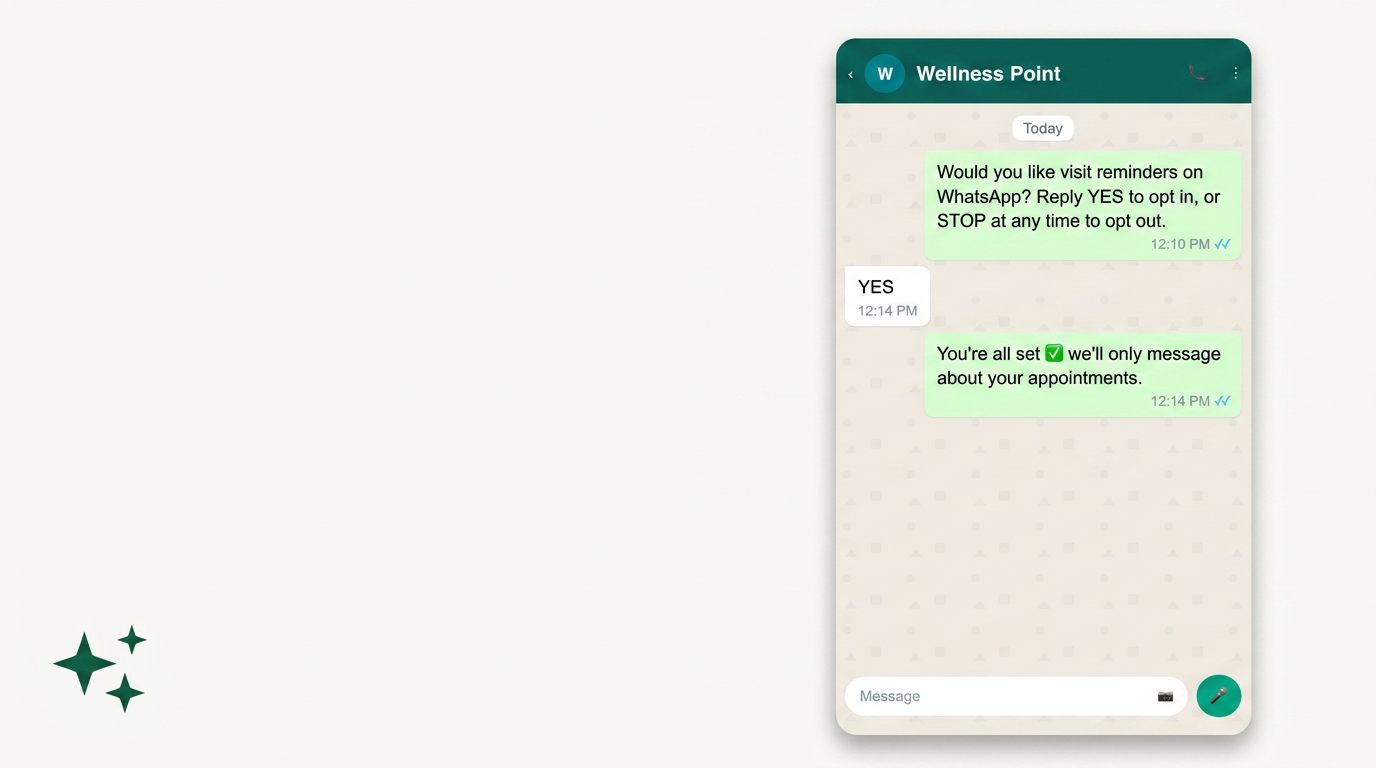
Rebuilt the opt-in language. Their old opt-in was a checkbox that said "receive updates from us". That does not clear the bar. Tata Communications' overview of WhatsApp business rules notes that businesses must obtain customer opt-ins and use approved templates or risk account suspension. We rewrote the consent so it names WhatsApp explicitly, names the business, names what will be sent (appointment and service updates), and gives an opt-out instruction. Cleaner consent produces fewer blocks, and blocks are what move a quality rating.
Confirmed which API they were actually on. Message Central's US guidance records that Meta shut down the legacy On-Premises API, so US businesses now operate on Cloud API. This one took a single phone call to their provider and would have taken a week of confused debugging if it had been left until the rebuild was live.
Retrained the office, properly. The dispatch and front-desk team had to understand why the promotional line was coming out of the confirmation message. Told only "compliance says so", they route around it. Told that a paused template is a plumbing fault that eventually drops pressure across the whole building, they enforce it on each other. Staff who understand why a system helps them will train the next hire; staff who fear it will quietly undermine anything you install, and change management is most of what makes an implementation work while getting a fraction of the budget.
What happened after
We will not put a number on the revenue outcome, because this is a composite and a fabricated figure would be worth less than nothing to you. What we can describe is the shape of the change.
Their total WhatsApp send volume fell substantially. Their Meta messaging spend fell with it, because the paused category was the expensive one. The conversation count, meaning actual two-way exchanges with customers, went up, because the service-window strategy is built on replies rather than broadcasts. Their quality rating, which had drifted before the rebuild, settled back in green and held there. The seasonal promotion did not disappear; it moved into the booking conversation and into email, where the offer can be long and detailed and nobody is paying per message.
The uncomfortable part: the campaigns that used to produce a visible spike in the calendar the day after a send no longer exist. Leadership missed that spike. It took a full quarter of steady booking flow before anyone stopped asking when the promotions were coming back.
What generalises to your business
Three things transfer to any US operator sitting on the same fork.
- Audit before you decide. Most companies do not know what share of their WhatsApp value came from marketing templates versus utility and service-window messaging. Run the split before you renew or cancel anything. Our experience is that the assumption is usually wrong in the same direction.
- Protect the number. The pause is a category restriction rather than an account penalty, but sloppy consent and mislabelled templates during a pause are how a healthy number goes yellow anyway. If yours has already drifted, the recovery path is in our note on moving yellow back to green, and it is worth knowing what triggers a review before you find out the hard way.
- Do not build a bespoke workaround. We have seen US firms commission custom systems to route around the pause. Build custom only when the workflow itself is your competitive advantage. Message routing rarely is; buy it, configure it, and spend your team's time on the part customers actually notice.
The general principle, and the reason we keep writing about country-specific rules: WhatsApp behaves like a different product in the United States than it does in the UAE or Brazil, and a strategy copied from a market where marketing templates still deliver will underperform badly on +1 numbers. Learnmind, the Dubai consultancy that builds WhatsApp automation and AI receptionists for service businesses, spends a meaningful share of its time telling clients which of their assumptions are country-specific.
Frequently asked questions
Can US businesses still send WhatsApp marketing messages?
No. Meta paused delivery of WhatsApp marketing template messages to United States phone numbers on April 1, 2025, and the pause was still active as of July 2026 with no announced end date. Utility, authentication, and free-form service-window messages continue to deliver to +1 numbers.
How long will the WhatsApp marketing pause in the United States last?
Meta has not announced an end date. It was described as temporary when introduced, but it has now run for well over a year, so we plan client programmes on the assumption that it stays in place and treat any reversal as upside.
What can I still send to US customers on WhatsApp?
Utility templates such as order confirmations, appointment reminders and shipping updates, authentication templates such as one-time passcodes, and any free-form reply sent within 24 hours of a customer's own message. That last category is where most promotional intent should now live.
Does the US pause affect my WhatsApp account quality rating?
The pause itself is a delivery restriction on a message category and not a penalty against your number. Your rating still moves on user blocks, reports and template quality, and Meta's documentation warns that repeatedly sending low-quality templates can eventually affect the phone number.
Should I move my US messaging to SMS instead?
Only for the promotional volume you genuinely cannot deliver another way. Moving confirmations, arrival notices and two-way conversations off WhatsApp usually costs more than it saves, because those are the messages customers reply to.
If you run a US number and want a second opinion, send us your approved template list and the exact wording of your opt-in. We will tell you which templates are miscategorised and whether your consent language holds up, no charge and no deck.