Most of these decisions land on a desk for one of three reasons. A software contract is up for renewal and someone finally read the line item. A clinic manager is deciding whether to hire a third receptionist or automate the front desk. Or an agency has outgrown the WhatsApp Business app on a shared phone and discovered that the number they have been using for two years cannot be moved anywhere useful without a plan.
Whichever fork you are standing at, the question underneath it is the same: which connection to WhatsApp do you commit to, and how expensive is it to change your mind later? Here is how we weigh it, and who can stop reading now.
Two readers can leave immediately
If you have no developer, no technical partner, and no plan to acquire either, none of these three options is your answer on its own. You need a packaged platform sitting on top of one of them, and the BSP underneath matters far less than whether the platform's support team answers you on a Thursday afternoon. Pick the interface your staff will actually open.
If, at the opposite end, you already run Twilio for SMS or voice and your team ships code every week, stop deliberating. As the Spanish consultancy Engrana notes in its Twilio and 360dialog comparison, Twilio's WhatsApp API will feel familiar to a team already living inside its SDKs for Node, Python, Ruby, Java, PHP, C# and Go. Consolidated billing, logging and on-call knowledge is worth more than the markup you would save elsewhere. Everyone still reading has a genuine decision.
What each of the three actually is
Twilio, 360dialog and Meta's direct Cloud API are three different distances from WhatsApp itself. Twilio is a full communications platform that wraps WhatsApp in its own SDKs, message objects and support contract, which suits teams with developers who want one vendor across channels. 360dialog is an official Business Solution Provider with a thinner REST layer that stays close to Meta's own API shape and generally carries a lower markup on message fees. Meta's Cloud API is direct access with no intermediary at all: Meta hosts it, Meta bills you, and nobody sits between you and the platform when something breaks.
In tailoring terms, Cloud API is buying the cloth and cutting it yourself, 360dialog is the alterations tailor who works to your measurements and charges for the work rather than the wardrobe, and Twilio is the full-service house that makes the suit, the shirts and the coat and keeps your pattern on file. All three can produce a jacket that fits. What differs is who holds the scissors when a seam gives.

One thing that does not differ, and that clients ask about constantly: encryption. Meta's own platform documentation confirms that with Cloud API, every WhatsApp message is still protected by Signal protocol encryption before it leaves the device. Choosing a BSP does not weaken message security in transit. It changes who stores, logs and processes the data after delivery, which is a different question and a more important one for anyone operating under UAE data protection obligations.
Cost, and where the markup actually hides
Everybody compares per-message prices and almost nobody compares total cost correctly. The Meta conversation fee is the same fee no matter who you buy through. What changes is the BSP's markup on top and the platform fees around it.
Twilio charges Meta's conversation fee plus its own markup, and per the Ominiflow pricing guide, total cost depends on volume, country and conversation type, with the same guide noting that 360dialog is often cheaper on BSP markup for API-only use cases. WasenderApi's comparison makes the point more bluntly, describing Twilio as highly scalable with higher costs that may be prohibitive for small businesses and startups. Cloud API direct removes BSP markup entirely, because there is no BSP.
Then there is the cost nobody puts in the spreadsheet: engineering hours. Going direct to Cloud API means you own webhook handling, retry logic, template submission, phone number registration, error taxonomies and the on-call rota. For a five-person salon group, saving a few dirhams per conversation while paying a developer to babysit webhooks is a bad trade. For a clinic group sending high volumes across several branches, the arithmetic flips, and it flips faster than most operators expect.
- Twilio: highest per-message cost, lowest integration cost if you already run Twilio.
- 360dialog: lower markup, still gives you an account manager and onboarding help.
- Cloud API direct: no markup, all the maintenance.
Who picks up the phone when templates get rejected
This dimension decides more real outcomes than pricing does, and it is the one operators underweight. Template rejections, quality rating drops and number registration failures are routine events, not exceptions. What matters is how fast you get from broken to working.
With Twilio you get documentation depth, a large public knowledge base and, at the right support tier, a real escalation path. Engrana points out that Twilio's ecosystem of examples and Stack Overflow answers is part of the product, which is genuinely useful at two in the morning. With 360dialog you get a smaller, more focused support relationship and a partner who deals in WABA semantics all day. With Cloud API direct, your support is Meta's developer documentation and whatever community you can find. That is a workable answer for a team with a competent backend developer. It is a poor answer for a two-clinic dental group whose IT is a part-time contractor.
The honest limit here: support quality varies by tier and by region, and none of these vendors will fix a badly written template for you. If your opt-in language is weak, no amount of support saves the quality rating.
Compliance and where your customer data comes to rest
The SleekFlow guide to choosing a WhatsApp Web API notes that Twilio, 360dialog and SleekFlow are all official WhatsApp BSPs, so the underlying platform capabilities are the same across them. The compliance difference is about data handling, and here 360dialog has the stronger story for European data protection expectations, which matters to UAE businesses with EU clients or an EU parent company.
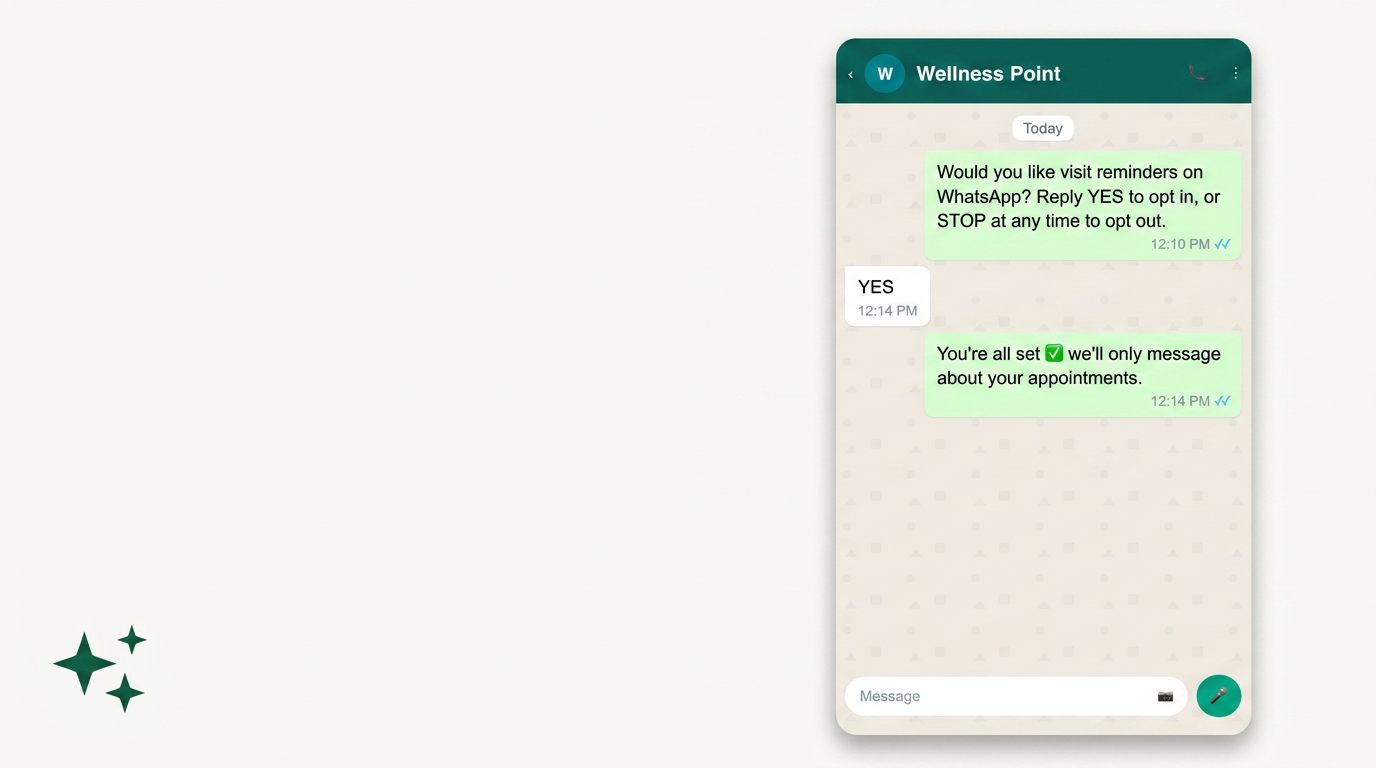
For our clients in Dubai, the sharper question is opt-in. Meta requires that a customer has given permission before your business sends them a template message, and that requirement holds identically whether you go through Twilio, 360dialog or straight to Cloud API. The BSP does not soften it. Neither does the local data protection position: we have written a full PDPL reference for reactivation because the single most common thing we are asked to build is a campaign against a list that was never permissioned properly in the first place. Your BSP choice does not fix that list. Cleaning it does.
What good opt-in capture looks like at the infrastructure level
Whichever provider you sit on, the plumbing needs to store three things per contact: when consent was given, through which surface it was given, and what the customer was told they would receive. Cloud API direct gives you total freedom to design that record and total responsibility to build it. Twilio and 360dialog give you the same freedom, but the tooling that resellers layer on top often ships something usable out of the box. If you cannot produce a consent record for a specific customer within a minute of being asked, your setup is not compliant regardless of the logo on the invoice.
Migration risk, or how expensive it is to be wrong
A WhatsApp Business number is tied to a WhatsApp Business Account, and moving that number between providers is possible but is not a five-minute job. Templates need resubmission. Webhook endpoints change. Anything that assumed the old provider's message payload shape needs rewriting. Conversations in flight during the switch are the ugly part.
We treat this the way a tailor treats seam allowance: you do not cut with zero margin just because the measurements are right today. Build the integration so that provider-specific code sits in one thin layer and everything else, your CRM writes, your routing, your automations, talks to your own internal shape. Then a provider change is an alteration rather than a re-make. Almost nobody does this on the first build, and almost everybody wishes they had by year two.
The practical consequence: choosing 360dialog or Cloud API direct keeps you closer to Meta's native API surface, which makes a future move cheaper. Choosing Twilio buys convenience now at the cost of a deeper migration later. That is not an argument against Twilio. It is an argument for knowing which one you are buying.
Attacking our own advice
We have just told you that lower markup and closeness to Meta's API are advantages. Here is where that guidance fails.
It fails for businesses whose real bottleneck is staff adoption, not infrastructure. We have watched implementations stall with the technology working perfectly and barely anyone using it, because reception staff kept answering the personal WhatsApp on the counter instead of the shared inbox. If that describes your team, the cheapest BSP in the world saves you nothing. Fix the workflow first, in phases, with one branch or one service line at a time. Slow rollouts beat big-bang rollouts consistently in our experience, and the reason is people, not code. We have gone deeper on that in our piece on rewriting operational habits.
It fails for businesses with no maintenance capacity. Cloud API direct looks free until Meta ships a change to a webhook payload and nobody notices for four days because no alert existed. Kanal's comparison of WhatsApp API providers puts it plainly: choose Twilio if you have a development team and want full control over the messaging infrastructure. Invert that and you get the honest rule. No development team, no direct Cloud API, and we have yet to see an exception hold up.
It breaks at scale in a specific way. Multi-branch operations with several numbers, several teams and shared customer records hit a coordination problem that no BSP solves. Which number replies when a patient who booked at Branch A messages the Branch B number? Whose CRM record wins? Kommunicate's Twilio and 360dialog breakdown is right that the two differ on pricing model, setup experience, message fees, integrations and the type of business each fits, but none of those differences touches this problem. It is an architecture question about your customer data, and it is the same question that decides whether your revenue cycle actually connects. Solve it before you shop for providers.
And a limit on the cost argument. If your total WhatsApp volume is small, the markup difference between providers is real but trivial in absolute dirhams. Optimising it is a distraction from the thing that actually moves revenue, which is answering people faster than your competitor does.
The verdict, by situation
Single-location clinic, salon or agency, no in-house developer, modest monthly volume: 360dialog, accessed through a partner or platform that gives you a usable inbox. Lower markup than Twilio, close enough to Meta's API that your options stay open, and a support relationship you can actually use.
You already run Twilio for SMS, voice or verification: Twilio. Consolidate. The markup is the price of not maintaining a second vendor relationship, a second billing surface and a second set of failure modes.
Multi-branch group with an in-house or retained development team, high volume, custom CRM: Cloud API direct, with the abstraction layer built from day one. You have the capacity to own it and the volume to make removing markup meaningful.
Real estate agency with heavy outbound and lead routing: 360dialog. Your constraint is template approval speed, consent hygiene and routing logic, not SDK breadth, and you want a partner who lives in WABA territory rather than a general communications platform.
Anyone whose staff are still replying from personal phones: none of the above, yet. Sort the front-of-house process, then pick. WhatsApp is the primary channel for service businesses in this market rather than a secondary one, and a channel that important deserves a process before it gets a provider.
Quick answers
Is 360dialog cheaper than Twilio for WhatsApp?
Often yes on BSP markup for API-only use cases, according to Ominiflow's pricing guide. Both charge Meta's underlying conversation fee, so the difference sits in the provider's own margin and the platform fees around it.
Can I use Meta's Cloud API without any BSP?
Yes, Meta's Cloud API is direct access with no intermediary, but you take on webhook handling, number registration, template management and all monitoring yourself. Without a developer who owns it, this is the option most likely to leave you silently broken.
Do I need customer opt-in on all three options?
Yes. Meta's opt-in requirement for template messages applies identically whether you connect through Twilio, 360dialog or Cloud API direct, and your provider choice does not change what consent record you need to hold.
How hard is it to move my WhatsApp number to a different BSP?
It is doable but not trivial: templates need resubmitting, webhooks need repointing, and any code that assumed the old provider's payload shape needs rewriting. Staying closer to Meta's native API surface, as 360dialog and Cloud API do, makes a future move cheaper.
Which option is best for a small clinic in Dubai?
For a single-location clinic without an in-house developer, 360dialog through a partner or platform is usually the right fit, because it keeps markup low while still giving you onboarding and support. Cloud API direct is the wrong choice without someone to maintain it.
Which of these three are you on right now, and could you say within a minute what your markup and your consent record look like? Learnmind is an AI customer-communication consultancy in Dubai, and comparing an existing WhatsApp setup against the alternatives, with migration cost included, is something we do most weeks.