It is 5:40pm on a Tuesday in a tutoring center off Sheikh Zayed Road. Six students are changing rooms, two mothers are waiting at the desk to pay for next term, and the phone has rung four times in nine minutes. The receptionist picks up the third call, promises to call back, and writes a mobile number on the back of a printed timetable. That number is still sitting on the desk on Thursday morning.
That scene is a composite, assembled from the kind of thing we see at centers we work with in the UAE rather than one documented afternoon, and every example in this article works the same way. But the collision it describes is real, and it comes down to arithmetic: the hour parents make enrolment decisions is the hour your classrooms are fullest. That is the problem an AI receptionist is built for, and it is worth giving away the conclusion now rather than making you read to the end for it.
The short answer, before the seven signs
An AI receptionist for tutoring centers is a voice and chat agent that answers every inbound call and WhatsApp message instantly, at any hour, using your real schedule, fees and subject list, then books trials, answers routine parent questions and hands genuinely complex conversations to a named human. Tutoring centers should choose one over another front desk hire when the bottleneck is coverage (calls arriving after hours, during the 4pm to 8pm rush, or in parallel) rather than capacity during quiet office hours. A second receptionist adds one more person on one more phone line for eight hours a day; an AI receptionist adds unlimited simultaneous lines for twenty-four.
The mechanism is consistent and unremarkable: always-on answering and prompt pickup convert more of the enrolment inquiries you already receive, because scheduling and routine questions get handled while the parent is still deciding rather than a day later. Harvard Business Review's study of online sales leads reached the same conclusion about speed: most companies simply do not respond fast enough. No new marketing spend. Same call volume, more enrolments. If you are weighing a switch, we have laid out the questions buyers ask before they commit.
Now the seven signs, ordered by how much money each one costs you. The first is first because it is the only one where the loss is invisible: you never find out the call happened.
Calls ring out between 4pm and 8pm and nobody logs them
This is the expensive one. Your teaching peak and your inquiry peak are the same four hours, which is a scheduling collision no amount of goodwill fixes. Parents call when they finish work. Your desk staff are checking in students, chasing a tutor who is late, and processing a card payment when that call lands.
Weather forecasters have a name for the storm that forms over open ocean with no buoy beneath it: the event happens, the damage is real, and nothing in the instrument record shows it. Missed calls at a tutoring center behave the same way. The phone system logs a ring. Your CRM logs nothing. The parent logs a decision.
Before you do anything else, pull the call report from your provider for the last thirty days and split answered from unanswered by hour of day. Most owners have never looked at it broken down that way, and the 5pm column is usually the one that changes the conversation. If the unanswered bar is tallest exactly when your classrooms are fullest, you have found your case. A new hire staffing that window is one more person answering one call at a time during the only hours when three parents ring simultaneously.
Inquiries arrive after closing and sit until morning
In the centers we work with, the second-largest leak is the 9pm WhatsApp message. A parent finishes dinner, looks at a term report, decides something has to change, and messages three centers. The one that replies with the trial slot, the subject list and the fee gets the child. Everyone else replies at 9:15 the next morning to a parent who has already committed.
An AI receptionist covers this without asking anyone to work a night shift. The nuance is what it should say at that hour. Our preference is that the agent does not try to close a high-value decision alone at 10pm. It confirms availability, answers with real answers (level, subject, tutor availability, location, timing), books a provisional trial, and flags the thread for a human to personally confirm at opening. Automate the repetitive, personalise the meaningful. The booking is repetitive; the reassurance a worried parent needs about their child's Grade 10 chemistry belongs with a human.
The same eleven questions eat your desk staff's day
Every tutoring center has a fixed question set. Do you teach the British curriculum or American. Is there a Saturday batch. How much for eight sessions. Do you do IGCSE physics. Where do I park. Can my daughter join mid-term. What is the tutor-to-student ratio. Do you offer a free assessment. Is there a sibling discount. Can we pay monthly. What time does the 4pm batch actually end.
Write yours down. If the list is that short and that stable, it is closer to a forecast model than a conversation: the same inputs produce the same output every time, and a well-built agent runs it faster and more consistently than a person on their fourth hour at a busy desk. What is left over after you subtract those eleven questions is the actual job of a front desk person, which is reading the parent standing in front of them and making the center feel like somewhere they want to leave their child.
What belongs with a human, always
- Complaints about a tutor or a session, immediately, to a named person
- Any conversation where a parent mentions a learning difficulty or a diagnosis
- Refunds, credits and mid-term cancellations
- A trial that went badly and needs recovering
Parents no-show trials and re-book by phone tag
Trial no-shows are the quietest cost in tutoring because the slot looks free on the calendar afterwards. It was not free. A tutor was held, a room was held, and the parent who wanted that slot was told it was taken.
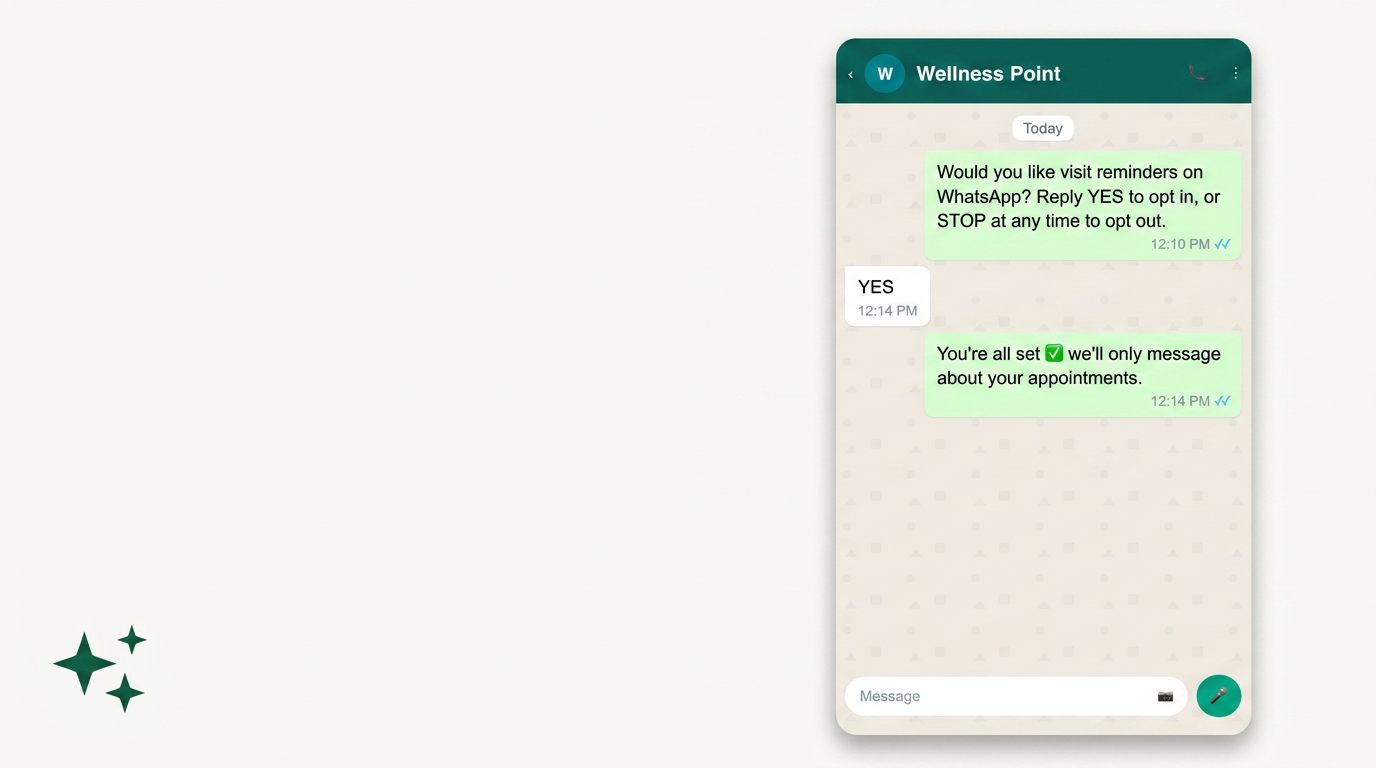
Reminders reliably cut a meaningful share of this, and they are the least glamorous automation we install. A systematic review in BMJ Open of digital appointment notifications found text reminders produced roughly a quarter fewer missed appointments across clinic trials. So: a WhatsApp reminder 24 hours out carrying the tutor's name, the room, the subject and a one-tap reschedule link. Then a second, shorter one three hours before, because the same review found multiple notifications lifted attendance by 25% against 6% for a single message. The reschedule link matters more than the reminder itself: a parent who cannot make Thursday will rarely phone to say so, but they will tap a button that offers Saturday.
The failure mode is over-sending. A center that messages about the trial, then the confirmation, then the payment, then the first session, in four separate templates inside a day, teaches parents to mute the thread, and Meta's developer documentation for message templates says the platform will act on that for them: templates get paused for negative feedback from customers or low read rates. Fewer, denser messages beat frequent thin ones.
One WhatsApp number, three staff, and a thread nobody owns
This sign shows up as a specific complaint: a parent says they already explained this to someone. They did. They explained it to whoever had the phone open, and the next person to reply had no idea. WhatsApp's own guide to organizing a shared inbox notes the Business app supports up to four linked devices on one number, so three staff can share it from their own phones. What the app never gives you is ownership: every thread belongs to whoever opens it first, with no assignee, no state and no routing.
That layer arrives when the same number moves to the WhatsApp Business Platform, the API tier Meta points teams toward when they need automation, CRM integration and more hands than four devices allow. An AI receptionist sits on that API, so every thread gets a state, an assignee and a history, and messages route by intent rather than by whoever is nearest the phone. We have written separately about the routing patterns that keep a single number sane across a team, and the same rules apply whether you are a clinic or a center running eleven tutors. One thing to settle before you start: what an automated agent may send, and when, is governed by Meta's Business Messaging Policy, so it pays to read the messaging rules in plain language rather than learn them through a rejected template.
You are about to post a job ad because the desk is drowning
This is the sign that deserves arithmetic rather than argument, so here is how we ask owners to lay it out before they hire.
A second full-time front desk person in the UAE carries salary, visa and medical insurance, gratuity accrual, training time before they are useful, and cover during annual leave. Against that, list what the role actually delivers: presence at the desk during office hours, one call answered at a time, no coverage on weekends or after 8pm, and a ramp of several weeks before they know your fee structure well enough to quote it with confidence. Note that the weekend here means Saturday and Sunday: per the official UAE government portal, most private companies close on Sundays or on both Saturday and Sunday, and Friday is a normal working day your hire would be expected to cover.
Then price the same window unstaffed. Take the missed-call report from the first section. Take your average enrolment value, your historical rate of turning an inquiry into a trial, and a trial into an enrolment. Multiply. That number is your coverage gap in dirhams, and it is the only honest benchmark for either option.
The answer is not automatically automation. If your desk is drowning at 11am on a Wednesday with walk-ins, payment queries and physical paperwork, hire the person. Nothing digital greets a family at the door. But if the drowning happens on the phone, in parallel, at the hours when a human can only be in one conversation, a hire is the wrong instrument for the measurement you just took.
Your enrolment funnel has no record between "called" and "joined"
Ask an owner how many people inquired last month and you tend to get a guess. Ask how many enrolled and you get an exact number, because that one hit the bank account. The gap between those two facts is where every improvement in tutoring marketing either works or does not, and most centers are flying it blind.
An AI receptionist creates that record as a by-product of doing its job. Every call and message becomes a dated entry with the subject asked about, the year group, the source, and what happened next. After a term you can see which subject inquiries convert, which hours produce the best-quality leads, and where in the sequence parents go quiet. Forecasters improve a model by adding stations that record what actually happened.
Three things an AI receptionist will not fix at your center
Three limits worth knowing before you sign anything.
It will not rescue a bad schedule. If your Saturday IGCSE batch is genuinely full and you have no tutor to open another, an agent booking trials into it only moves the disappointment closer to the parent. Fix the capacity, then automate the intake.
It does not survive a big-bang rollout. Switch everything on in one weekend, skip the staff training on handovers, and the first awkward escalation is enough to convince the team the whole thing was a mistake. Adoption is the bottleneck, not the technology. Start with after-hours only. Two weeks later add the 4pm to 8pm overflow. Extend it to daytime first-response only once your desk staff feel relieved rather than threatened.
It cannot carry an emotional conversation. A parent whose child is failing and who is embarrassed about it needs a person. Build the escalation trigger for that and check weekly that it fires.
What a phased install looks like at a center
The order we run it in for tutoring: after-hours WhatsApp and voice first, because it is the lowest-risk window and nobody's job is being touched. Then trial reminders and reschedule links. Then peak-hour call overflow, where the agent picks up only what your desk cannot. Then the FAQ layer during office hours. Last, the reporting view that closes the funnel-record gap.
Each stage is separated by enough time for your team to complain about it, which is the point. Learnmind is an AI customer-communication consultancy in Dubai, and we spend more time on that adoption sequence than on the build itself, because it is what decides whether a center is still using the system a year later.
What center owners ask
Can an AI receptionist book a trial class into our tutor timetable?
Yes, provided your timetable lives somewhere it can read, such as a calendar or booking system with an API. The agent checks tutor and room availability in real time, holds the slot, and confirms the subject, level and location back to the parent.
What happens when a parent asks about a specific curriculum or exam board?
The agent answers from your own subject and board list, so IGCSE, A-Level, IB and American curriculum questions get an accurate reply rather than a hedge. Anything outside that list, such as a board you do not teach, should route to a human instead of improvising.
Will parents know they are speaking to an AI receptionist?
Yes, and on WhatsApp this is a platform condition rather than a courtesy: the Business Messaging Policy requires businesses using automation to keep clear escalation paths to a human. We build the disclosure and the handoff in from day one. The agent introduces itself as the center's assistant and offers a human at any point, which tends to reduce friction rather than create it, because the parent knows exactly what they are dealing with.
Can it handle enrolment season without extra setup?
Yes, and peak season is where the difference shows most, because an AI receptionist takes unlimited parallel calls and messages while a front desk takes one. The setup that matters beforehand is an accurate fee list, an up-to-date timetable and clear escalation rules for anything it should not answer.
Pull your last thirty days of call data, split answered from unanswered by hour, and let the 5pm column tell you whether your problem is coverage or capacity before you spend a dirham on either fix. Learnmind does that mapping, and the install behind it, for centers that want it done properly.