Most WhatsApp Flows booking forms fail for reasons that have nothing to do with code.
We say that as people who write the endpoint code. The RSA key pair, the AES payload decryption, the screen routing, all of it is a solved problem with documented answers. You will get it working in a day or two. What kills the project is that someone designed a seven-screen form asking for a passport number, an insurance provider and a preferred practitioner, then wired it to a live calendar that had not been reconciled in three weeks. The encryption worked perfectly. The booking still did not happen.
So the questions below are sequenced the way they actually arrive: what the thing is, how to make it run, how to keep it legal, and then the uncomfortable ones about where it breaks. We install these for clinics, salons and property agencies in the UAE, and we have watched enough of them go live to know which questions are worth answering at length and which get a paragraph. Where a detail depends on Meta's current implementation guide, check it against the docs before you build; Meta changes the specifics more often than the blogs writing about it do.
What actually is a WhatsApp Flows endpoint, and do I even need one for a booking form?
A WhatsApp Flows endpoint is an HTTPS server you control that receives encrypted requests from WhatsApp during a Flow, decrypts them, and returns the data for the next screen, and you only need one if your booking form has to react to live information. A static Flow (name, phone, preferred day, free-text note) needs no endpoint at all; WhatsApp collects the answers and, as Meta's guide to receiving Flow responses describes, delivers them to your webhook when the user submits. The moment you want to show real available time slots, validate a chosen date against your calendar, or branch the form based on which service the person picked, you need the endpoint, because that logic lives on your server, outside the Flow definition.
That distinction saves projects. We have had clients insist on an endpoint from day one and then discover that their treatment menu changes twice a year, their availability is generous, and a static Flow dropping into a shared inbox would have covered almost everything they wanted. Build the static version first. Add the endpoint when the absence of live data starts costing you bookings you can name.

How does the encryption actually work? I keep seeing RSA and AES mentioned together
Both are used, for different jobs. Meta's guide to implementing your Flow endpoint uses RSA for key exchange and AES for the payload itself. You generate an RSA key pair, register the public key against your WhatsApp Business account, and keep the private key on your server. When a user interacts with a Flow screen, WhatsApp encrypts the request body with a 128-bit AES key in GCM mode, encrypts that AES key with your RSA public key using OAEP padding (SHA-256 with MGF1), and sends you both. You decrypt the AES key with your private key, decrypt the body, and encrypt your response with the same AES key, using an initialization vector made by inverting every byte of the request IV (each byte XORed with 0xFF).
If that sounds like more moving parts than it needs to be, think of how a building gets wired. The mains cable does the bulk work, carrying current to every socket (AES, fast, designed for volume). The key to the locked meter cabinet travels separately, cut for one lock and useless anywhere else (RSA, slow, but it only has to protect something tiny). Registering your public key with Meta plays the role of circuit certification: the installation is signed off once against a named account, and nothing is treated as live until that paperwork is lodged. Nobody pushes a building's full load through a key barrel, and nobody leaves the cabinet key taped to the door.
The three things that go wrong here
- Getting the response encryption subtly wrong. The response uses the same AES key as the request but a flipped IV, every byte of the request's initialization vector XORed with 0xFF. Miss the flip and the user sees a generic error while your own logs look clean, which is the worst possible combination for debugging.
- Key management across environments. Your staging Flow and your production Flow need their own key pairs registered against the right business account. We have watched a team lose a working day because staging keys had been uploaded against the production number.
- Private key storage. It goes in a secrets manager, and only there; treat a repo, or an environment variable pasted into a screenshot in a group chat, as a breach. This is booking data for named individuals, in a clinic it is medical by implication, and the UAE government's guidance on the Personal Data Protection Law obliges any company holding personal data to secure it and maintain its confidentiality.
What does the data exchange payload actually contain, and what am I supposed to send back?
Once decrypted, the request carries an action that tells you why WhatsApp is calling (INIT when the Flow opens, data_exchange when a screen submits, BACK, or ping for health checks), the screen name, a flow_token identifying that session, and a data object with whatever the user just entered. The contract is pinned by the data_api_version your Flow JSON declares, 3.0 at the time of writing. Your server inspects the action, decides what happens next, and returns a JSON response naming the next screen and the data that screen needs to render, or a terminal response that closes the Flow and hands the final payload to your webhook. Meta's endpoint reference documents the exact request and response shapes; treat that page as the source of truth, because Meta updates it more often than anyone updates the articles written about it, this one included.
The practical shape for a booking form: screen one collects service type, your endpoint responds with screen two carrying the next available dates for practitioners qualified for that service, screen two submits a date, your endpoint responds with screen three carrying that day's actual time slots, screen three submits and you return the completion response. That is three round trips to your server. Each one is a chance for your server to be slow, so treat response time as a product decision with a budget attached. A user sitting in front of a spinner inside a chat window, where every other message has been instant, does not wait politely.
Hold the slot at the second screen, not at completion. If two people are picking the same 4pm on a Tuesday, the one who taps confirm second gets a booking your calendar cannot honour, and your reception team finds out when the patient arrives. A short soft lock, released if the Flow is abandoned, prevents a category of problem that is miserable to unwind by hand.
Does sending someone a Flow require opt-in, or does it count as a reply?
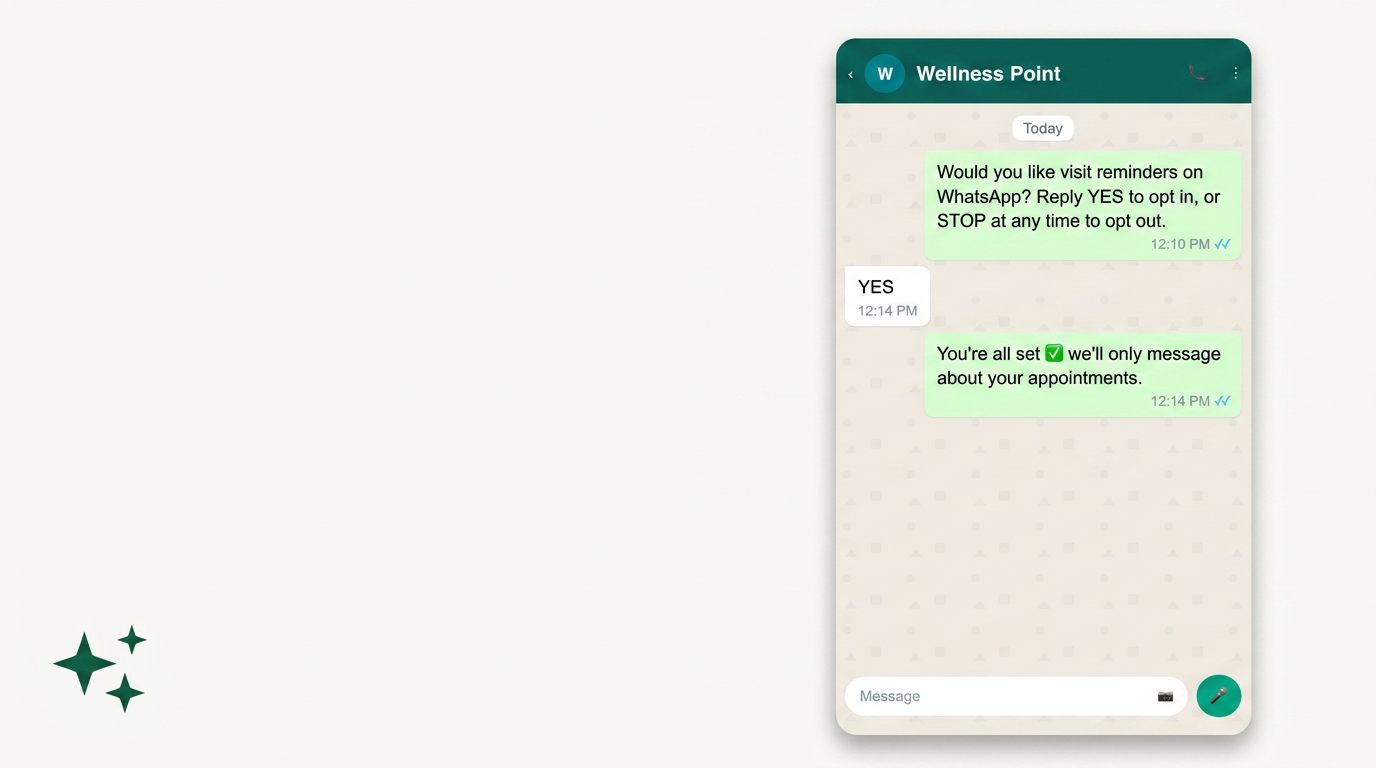
It depends entirely on whether you are inside an open customer service window. If the customer messaged you and you are replying within the window Meta allows for free-form responses, you can send a Flow as a normal interactive message. Outside that window, Meta's guide to sending a Flow requires it to travel inside a template message with a Flow button, and that template must reach APPROVED status before it can be sent. Meta's opt-in requirements apply to that template: the person must have clearly agreed to receive messages from your business on WhatsApp, in a place where your business name was clearly stated.
Where teams get themselves into trouble is treating a booking Flow as harmless because it is useful. Meta does not grade on usefulness. A reactivation campaign pushing booking Flows at a list of last year's clients who never gave WhatsApp permission is a policy violation with a helpful interface attached. If you are unsure how much of your current practice is defensible, we wrote a plain reading of the platform terms covering what counts as valid opt-in and what does not.
One more thing on consent: keep a record anyway. Timestamp, source, the exact wording shown. To be precise about whose rule that is, Meta's opt-in policy does not oblige you to store any of this; the record is what wins the argument when a number collects negative feedback and the quality rating starts sliding, because the conversation with support goes very differently if you can produce the opt-in trail. Under UAE data protection law, consent you cannot evidence is consent you will struggle to rely on.
Should the Flow be triggered by a bot, or by a human agent?
Both, and the split matters more than the code does. An AI layer handling the front of the conversation should recognise clear booking intent and send the Flow immediately, because that is the fastest path for someone who already knows what they want. But the same Flow should also sit as a one-tap action inside your agent inbox, so a human mid-conversation can drop it in the moment the discussion reaches scheduling.
Our position has not moved: in service businesses, AI's job is to augment human connection. A patient asking whether a procedure will hurt wants a person, and the form comes after that person has reassured them. Build the Flow so a human can deploy it as a tool, and stop it firing automatically at anything resembling the word appointment. If your inbox is shared across several agents, the routing rules matter as much as the Flow itself; we have written up the patterns that keep one number sane when several people work it at once.
And keep the surrounding messages professional and warm. A booking Flow for a dermatology clinic introduced by a chatbot making jokes reads as unserious to someone nervous about their skin. Clear, calm, competent. That is the register.
Why do people open the Flow and never finish it?
Because you asked for something they could not answer while standing in a lift. Drop-off inside a Flow is almost always a design problem, and in our installations it clusters around a small number of causes.
- Fields that require a document. Emirates ID number, insurance policy number, vehicle chassis number. The user leaves to find it and does not come back. Collect these after the slot is held, in a follow-up, or at the front desk.
- Too many screens before any commitment. Every screen is a decision point where someone can put the phone down. Keep it to the minimum the booking genuinely needs, and be honest about which fields are for the customer's benefit and which are for your admin team's convenience.
- No visible availability until the end. If a user answers four questions and only then discovers nothing is free this week, they will not restart.
- Slow endpoint responses. Covered above, and worth repeating because it is the failure nobody instruments.
- Free-text where a choice would do. Typing is friction. Tapping is not.
Instrument the abandonment. Every request your endpoint receives tells you which screen the user reached; log the session token and screen name and you can see exactly where the cliff is. Very few operators ever look at this data, and the fix is usually deleting one field.
What happens to the data after submission, and where does the booking actually get created?
The completed Flow response arrives through the same webhook you use for every other message, inside interactive.nfm_reply.response_json on the message object, and from there it is your integration's job to write the booking into whatever system of record you use. There are two honest options. Either you create the booking directly in the practice management system or salon software through its API, or you create a provisional booking and drop a notification into the agent inbox for a human to confirm.
The second option is unglamorous and we recommend it more often than clients expect. Direct writes are clean when the underlying system is clean. When a clinic runs three calendars, one of which is a whiteboard, a provisional booking plus a human confirmation is the honest architecture. The Flow still did the work: it captured structured, validated intent from someone who was ready to book, which is a completely different asset from a message saying hi do you have anything Thursday.
Whatever you choose, store the Flow session token against the record. When someone calls to query the booking they made in chat, you want to reconstruct the exact screens and answers rather than guess at them.
When is a Flows endpoint the wrong tool for a booking form?
We would be selling you something if we pretended a Flows endpoint suits every business, so here is the argument against it.
It fails for businesses whose service cannot be described in a dropdown. A property agency booking viewings works well: unit, date, time. An aesthetics clinic where the correct treatment depends on a consultation does not, and a Flow that forces the client to self-diagnose from a menu produces bookings for the wrong service, which is worse than no booking at all. In those businesses the Flow belongs after the consultation.
It fails when availability is genuinely scarce. If your senior stylist is booked out for weeks, a real-time slot picker mostly shows people what they cannot have. A waitlist conversation handled by a person converts better than an honest calendar.
It fails at very small scale. A two-chair clinic taking a handful of bookings a day does not have a bottleneck an endpoint can solve. The build cost, the key management, the monitoring, the version updates when Meta ships changes to the Flow specification, all of it has to be carried by volume. Below a certain volume, a static Flow or a well-run shared inbox wins on every measure that matters.
And things break at scale in specific ways. Endpoint downtime is visible to customers instantly, because there is no graceful degradation inside a Flow; the user sees an error and leaves. Concurrency on popular slots turns into double bookings unless you built the soft lock. Multi-branch businesses discover that one Flow with a branch selector becomes unmaintainable once branches carry different services, different practitioners and different working days, and end up needing per-branch Flows sharing an endpoint with careful routing. Meta also retires older Flow JSON versions on a published schedule: its versioning policy freezes a version first, so new Flows cannot target it while existing ones still send, then expires it, at which point Flows built on it can no longer be opened, typically with 90 days' notice. A Flow that has run untouched for a year will eventually need attention from someone who remembers how it was built.
The client stories in this piece are composited from several UAE installations, so treat these failure modes as a checklist to test your own build against.
How do I keep the thing alive after launch?
Monitor three things and you will catch almost everything: whether the endpoint is up at all, its response latency at the slow tail, and completion rate by screen. On the first, Meta's endpoint guide says WhatsApp may periodically send health-check requests with an action of ping, and your endpoint should answer them with {"data":{"status":"active"}}. Keep that handler working, but the pings are occasional and not guaranteed, so stand up your own external uptime and latency monitoring against the endpoint and alert from that. If the endpoint goes down, your Flow is dead for every user simultaneously, and you want the alert before your reception team tells you. And watch the slow tail, because averages hide exactly the requests that lose bookings.
Beyond that, review the actual bookings monthly against what reception hears on the phone. Forms drift out of alignment with the business faster than anyone expects: a service gets renamed, a practitioner leaves, a branch changes its Friday hours. We are Learnmind, and we install AI communication systems for UAE service businesses, which in practice means we spend far less time writing endpoints than keeping them truthful about what the business currently sells. The same discipline applies to the public side of your Meta presence, which is why we treat comment handling and DM automation as one system; there is more on that in our notes on the Meta AI comment manager.
Developer questions
Can I build a WhatsApp Flows booking form without writing any backend code?
Yes, if the form is static, meaning it collects answers and submits them without needing live availability. You build the screens in the Flow Builder and receive the completed payload on your webhook; the endpoint and its encryption only become necessary when a screen's content depends on data your server holds.
Does the WhatsApp Flows endpoint need to be publicly accessible?
It needs to accept POST requests at a publicly reachable HTTPS URL with a valid TLS certificate, because Meta's servers call it directly. You can harden it by rejecting anything that fails decryption or validation, but it cannot sit behind a private network or a VPN.
Do I need customer opt-in to send a booking Flow on WhatsApp?
Not if the customer messaged you first and you are replying inside the open customer service window. Outside that window the Flow must travel in an approved template, and Meta requires prior opt-in in which the person clearly agreed to receive messages from your business, with your business name clearly stated. Keeping a timestamped record of that consent is best practice for quality-rating disputes and an expectation under UAE data protection law, though Meta itself does not require the record.
Open your last fifty booking conversations and count how many messages it takes a customer to secure a slot; if the answer is three or fewer, you do not need a Flows endpoint yet. If it is eight, we will build the Flows endpoint for you: keys generated and registered, screens designed for completion, the calendar wired in, and the monitoring that keeps it alive after launch.